Book Clubs & Media
Here you’ll find discussion questions for Book Clubs for The Night Birds and Little Wolves, Thomas Maltman’s first two novels. Since The Land came out during the pandemic, a time when book clubs were not gathering, there are no discussion questions currently. The Book Club guide for Ashes to Ashes will be coming soon! Books on this page are listed from oldest to newest.
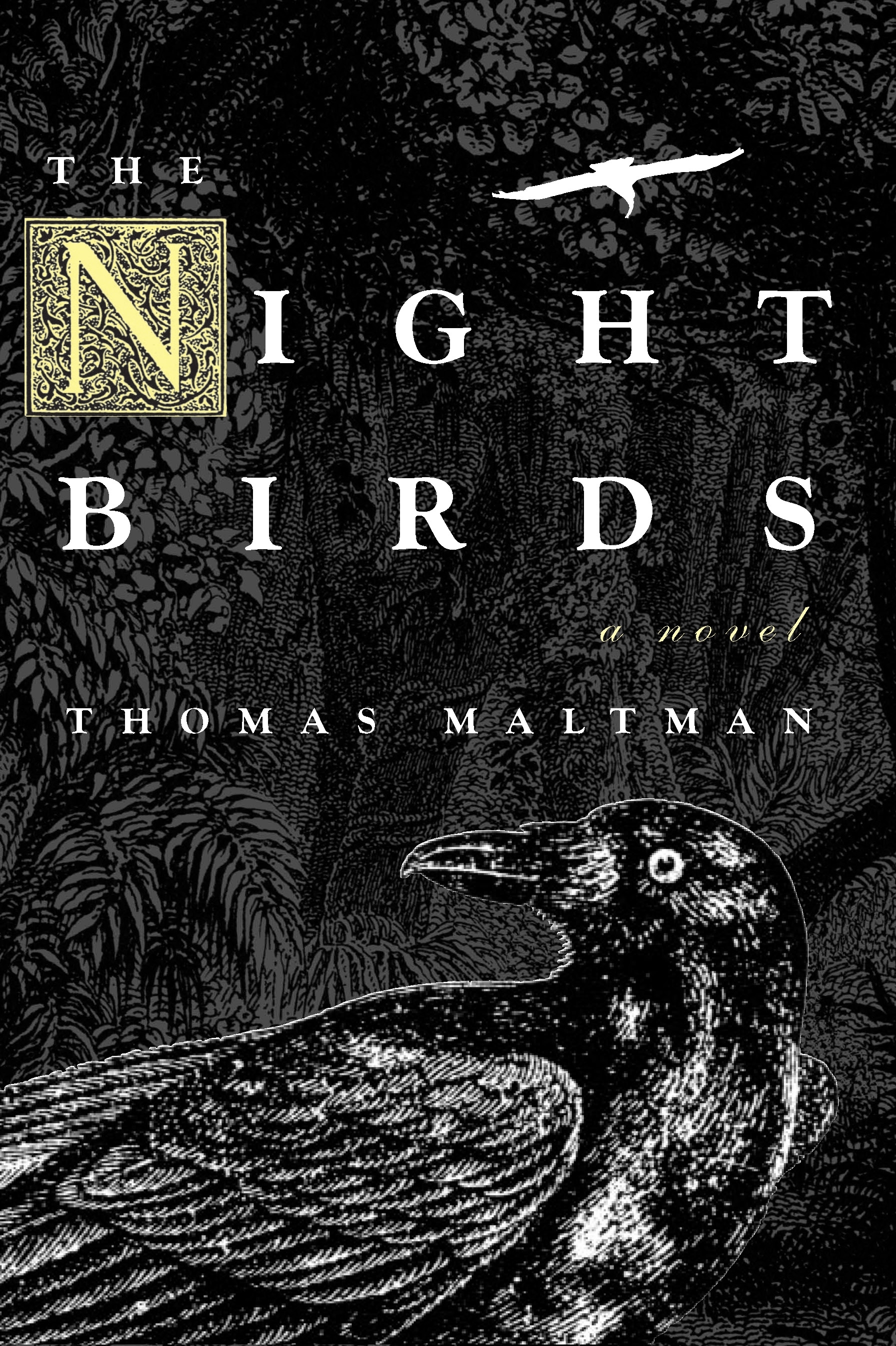
Read the award-winning novel of the Dakota Conflict of 1862. Winner of the Alex Award, the Friends of American Writers Literary Award, and a Spur Award, The Night Birds was most recently selected by the American Library Association as an “Outstanding Book for the College Bound.” Please scan down for the official discussion questions for book groups.
The intertwining story of three generations of German immigrants to the Midwest—their clashes with slaveholders, the Dakota uprising and its aftermath—is seen through the eyes of young Asa Senger, named for an uncle killed by an Indian friend. It is the unexpected appearance of Asa’s aunt Hazel, institutionalized since shortly after the mass hangings of thirty-eight Dakota warriors in Mankato in 1862, that reveals to him that the past is as close as his own heartbeat.
See what readers are saying about it on Goodreads by clicking this hyperlink: Customer Reviews
Praise for The Night Birds:
“We all set our sights on the Great American Novel. . . . [Thomas Maltman] comes impressively close to laying his hands on the grail.”
—Madison Smartt Bell, The Boston Globe
Link to full review in The Boston Globe, “A Poetic Imagining from Both Sides of a Cultural Frontier”
“Maltman’s prose and pacing flow from an expert hand. . . . His gaze is unflinching and balanced. . . . And while there is much loss in the novel, in the end there is salvation.”
—Robin Vidimos,Denver Post
Link to full review in The Denver Post, “From a Flock of Sorrows, Solace Takes Wing”
“Thomas Maltman’s debut novel, The Night Birds, soars and sings like a feathered angel.”
—Chicago Sun-Times
Book Groups: Reading Guide for The Night Birds
Soho Press Reading Group Guide
- The Night Birds centers around the Senger family, who live across the river from a small band of Dakota. Famous leaders such as Little Crow or Colonel Sibley are outside the frame. What does the novel gain by focusing on ordinary individuals rather than the names most often seen in history books?
- The novel alternates between two contrasting time periods, 1876 and 1862. Why did the author choose a dual narrative structure to tell this story? Do the alternating stories echo in any unexpected ways?
- “I was born in the shadow of the Great Sioux War,” Asa tell us in this first line of the story. In what ways do you find his voice compelling? When Hazel begins her story of the family’s journey from Missouri the writing switches to a third person perspective. What effect did this have on you as a reader?
- On page 23 Hazel tells a story of children gathered in a castle where the king has forbidden speech. Why does she tell the story in response to Cassie’s question? How does the theme of silence resonate throughout the novel?
- In a summer of war, Hazel survives by attempting to shed her German-American identity, seeking to become Dakota. Is she successful? How did you respond to her character and the choices she makes?
- The Rocky Mountain News compared Thomas Maltman to William Kittredge, saying he “shares the same respect for place as the crucible of character.” How does place impact the people in The Night Birds? Did the narrative transport you into the past?
- Discuss the title of the novel. What are the night birds? How does their presence become a motif for the story?
- “The mystic fatalism that suffuses The Night Birds comes from both sides of a cultural frontier” Madison Smartt Bell wrote in a Boston Globe review, “and it is often beautifully expressed.” Do you agree? How does German and Dakota folklore inform the characters’ lives? What are the spiritual dimensions of this story?
- The Dakota Conflict, once known as The Sioux Uprising, is considered a lost or forgotten episode in national history. How does the novel illuminate history without becoming “teachy?” Did Maltman achieve balance in his portrayal of German and Dakota relations?
- Did you find the ending satisfying? Why or why not? What scenes or images will linger in your imagination after you put the book away?

Praise for Little Wolves:
“A complicated portrait of a prairie town, a meditation on violence, a fantasia of myth and folklore, and a knockout murder mystery, Little Wolves is haunting, at times terrifying, a gothic cousin to Kent Haruf’s Plainsong. I loved this book.”
—Benjamin Percy, author of Red Moon, The Wilding and Refresh, Refresh
“This novel churns with the tension of a building prairie thunderstorm. Tom Maltman knows that dark truths can be hidden under open skies, and he knows the secrets of the bloodstained ax in the barn.”
—John Reimringer, author of Vestments
“The poetry of this prose and the suspense of the plot, along with the intensity of characterization will have many readers comparing Thomas Maltman to Cormac McCarthy—that greatest of compliments—for very good reason. This novel is a work of high art by the real thing.”
—Laura Kasischke, author of Space, in Chains and The Life Before Her Eyes
“My overwhelming sensation upon reading this book is that it is a masterwork of fiction. Not just a good book that’s interesting on multiple levels, but a great book that will stand the test of time. From the rich setting to the compelling characters, from the subtle but very powerful thread that fairy tales weave throughout the narrative to the suggestive implications of the power of story, I was completely spellbound. Add to this the mysteries surrounding the town and characters, and I felt, often, as though I were reading some contemporary version of Dosteovesky.”
—Peter Geye, author of Safe from the Sea
“Absolutely fantastic. Unnerving, gorgeously written…. The writing is haunting.”
—Caroline Leavitt, author of Pictures of You
“An ambitious mythic thriller that hums with energy and portent. Set under brooding prairie skies, Little Wolves has modern psychoses and generational wickedness, ravening devils and uneasy saints. It shifts and dodges like wind, and it rings with conviction and confidence.”
—Leif Enger, Author of Peace Like A River
Discussion Questions for Little Wolves
Prepared by the Iowa Center for the Book and Soho Press
- The little wolves of the title are a mysterious and ominous presence in the novel. What, if anything, do you think they represent?
- Throughout history, myths have been a mechanism for people to explain natural phenomena, and Little Wolves is steeped in mythology, both Norse and American. What role do natural phenomena (like snowstorms, or droughts) and the accompanying mythology play in the book?
- Why does Clara’s mother haunt her? In what ways has becoming pregnant changed her priorities and needs, if at all? In general, how does expecting a child—or losing a child—refocus and change the parents in Little Wolves? The town at large?
- Why does Sheriff Gunderson keep that hunting cabin back in the woods? In the oldest monster stories, evil came from outside, a threat from strangers. Are there monsters in this novel? How have different cultures explained evil through the ages?
- Abandonment of a child, through death or deliberate actions, is a common occurrence in this novel. If teenaged Seth had been orphaned prior to the murders would you have been willing to adopt him? Was he a hero or a villain?
- What is a citizen’s responsibility when he learns that a person in a position of civil authority is a lawbreaker and evil doer? Did Seth have options other than murder to remove the sheriff?
- Ministry seems an odd vocational choice for Logan, who was raised by agnostic parents. Clara also seems to be a very atypical minister’s wife. How did she struggle in that role and how did her beliefs evolve over time?
- Clara and Seth were both fascinated by the Germanic myths that she shared with her English classes. What did these myths mean to each of them? What was the nature of the relationship between Clara and Seth?
- Is Lone Mountain an ironic name for a prairie town situated next to a hill? What is the meaning of this name in the context of this story? Were Logan and Clara wrong in trying to make a home there?
- Seth seemed obsessed with “wergild” the concept of blood debt. What does this term mean? How did many years of bad blood between the Gunderson and Fallon families contribute to “wergild” for the present generations?
- Grizz is a complex character who has experienced tremendous loss. Why is it so important for him to bury his son on his own terms? What does he learn about vengeance?
- At the end of the novel, Grizz and Lee seem to be developing a sort of father/son relationship. How does the novel make sense of this unexpected relationship?
Excerpt from Little Wolves:
© Reprinted by permission. All rights reserved.
Book One
The Wolfing
She heard him from the mountain, a voice high and thin, breaking the night’s quiet. The cry was such as her own children made when she was gone too long searching for food to bring back to the den. It was the cry of something blind and helpless, a cry of hunger. She heard it and she could do no other thing but go toward it.
How it came to be alone in the tallgrass is a story for another time. She heard it with her sharp pointed ears and smelled it with her sharp black nose. Her nose told her the truth. It was not a wolf pup but a human baby, alone on a bed of prairie grass under the starry dark. She smelled on the breeze the horses that had come and gone, running hard. They had run away pulling a wagon that scarred deep ruts in the grass.
Her paws stepped in these ruts, found the gouges the horses had torn from the prairie. She paused, suspicious, and sniffed the ground and raised her nose and sniffed the wind. They had been here, but they were gone, except the baby. In the torn grass she smelled the fear on the horses and in the air she smelled something burning. She knew the ways of the wind and fire out on the prairie. The fire was a breathing thing, ever hungry. The fire would be here soon and find where the baby lay in his nest of grass.
She could not resist his crying because she was a First Mother who had birthed many children, and there were no others like her in this valley that smelled of smoke and terror. Her children had grown fat and happy until the coming of the Trapper the past moon, the Trapper who had killed her Mate, scattering the others, and then found the den where she had hidden her pups away.
The cries of the human baby traveled through the night and found her ears and went into her ears and into her blood. The cries opened up places inside her that had not yet gone dry, where milk recently flowed from her nipples to feed her pups and make them strong. It hurt to make milk again.
The coyote was skinny and mangy, her ribs poking from her pelt, and she needed food for herself, a plump mouse or jackrabbit. Here was this thing wrapped in a white cloth under the night sky. It had fallen from the running horses but the soft grasses had broken the fall. The running horses had not stopped for it. The child might as well have come from the stars themselves. And now it was alone here as she was alone. She did not think what to do, even if the baby bore the same tainted smell as the Trapper. Her body had told her when the milk rinsed out of her. She went toward it, sniffing tentatively at the corner of the cloth, and then touched the baby’s soft skin with her wet black nose. The baby quit crying. It gurgled, shocked.
The coyote licked it with her tongue and tasted the salty skin. If she had not been a First Mother, if another of her kind had found this pink bundle in the grass, the story might have been different. She stood over the child and crouched down so that it might reach her nipples and suckle. Yes, it hurt to make milk again. Her milk flowed out of her, emptying her of all she had to give, but her heart was full, as full as the night sky above.
When the child was done feeding she opened her jaws, clenched the white cloth, and lifted the child from the grass. She carried him away from the smell of burning where the prairie grasses would soon blossom with flames. The child rocked to and fro in his hammock of cloth. She took him in this manner to the place she called home, the mountain from which she had first heard his cries, the mountain where she had been alone for a time, but not any longer.
*
Her father had told her many stories, and this was just one, the one that reached furthest back into history, when settlers had gone to war with the Indians, and after the massacre, one child was saved by a feral mother. Her father told stories of a giant who lived inside a mountain, of wolves and lost children and the monsters they later became. The stories he told were the only answer he had for the absence of her mother. Though he never said so outright, they were about a childhood place he would never see again. She did not set them down on paper until after her father died and she herself was six months pregnant, a pastor’s wife, a stranger living in a small town.
Her hand shook as she wrote the words. She was in the room that was to be the nursery, and it was bare except for a small desk she planned to use as a changing table and the rocking chair where she sat with a spiral notebook spread open on her lap. Aqua-colored light soaked the room from blue curtains drawn across the window.
Yesterday, one of her students had rung the doorbell while she was down in the basement. She had looked up through a grimy basement window and beheld tennis shoes and the ragged edge of a coat. She saw the legs of this scarecrow figure and nothing more. He rang and rang that bell, and she just stood rooted there. A cold hand touched her shoulder, bidding her to stay. Even the baby she carried inside her was still and waiting. The bell kept ringing in her brain a long time after the figure in the coat went away.
And now the bells were ringing at church next door, as though this were any other Sunday, but she would not be joining her husband in the sanctuary. As pastor’s wife she did not want to face the congregation after what had happened. Her husband’s parishioners would greet her and smile. They desperately needed good news, and she was it. How are you? The baby? They would lay hands on her. The child was not hers alone; it belonged to them as well. They would touch her hair as though she had returned from the dead. They would speak once more of angels.
No. She needed to be alone here. She opened her notebook and began to write, balancing it on one knee. She could hear organ music and recognized the strains of “This Is My Father’s World” as the service began. Quaking voices. Such a gift, this murmur in her blood. The rocking soothed her, as did the words she scratched on the page with a fountain pen, a Montblanc Meiserstruck her father had given her when she graduated from high school.
Late last night she had seen the coyotes, three of them emerging from the cornfield late after dark. They did not howl at first but entered the cemetery behind the church with a short series of yips and barks, one and then the other, their calls braiding into a chorus, until eventually one howled in a language that was part of the great outer darkness. The coyotes weren’t supposed to be here; they were searching for something. They had come from the lone mountain like a storybook curse and roused the town with their plaintive singing, vanishing by daylight.
Clara Warren’s hand shook as she marked the words on the page because she knew she was trapped inside of one of her father’s stories, and the only way out was to write it down. She wrote as if her life depended on it, and maybe it did.
Book Club Questions Forthcoming for The Land and Ashes to Ashes


 thomas maltman